 On 25 February 2014, Martin Jacques gave the pre-dinner speech on China to an invited audience in the presence of HRH Crown Prince Guillaume of Luxembourg. It was organised by Luxembourg for Finance as a prelude to their Renminbi Forum 2014. Martin Jacques is photographed here with the Crown Prince. More photos from the event can be viewed here.

For some time now, it has been fashionable to say that we have begun what will be a “Pacific Century.” We have seen a flood of books of late, variations on the theme of When China Rules the World, as one put it. Certainly, in the aftermath of the 2008-09 financial crisis and Great Recession, this has been the conventional wisdom, a view shaped to a large extent by linear thinking. One of the most celebrated proponents of such views is the prolific former Singapore diplomat Kishore Mahbubani, who has written a series of well received books on Asia’s rise such as The New Asian Hemisphere.
In a recent article, Mahbubani has taken this linear logic to new heights (or depths, depending on your perspective) with the premise that America’s slide to number two economic status is “inevitable by 2019.” His premise appears to be that the prospect of yielding the top spot to China appears horrible and unnatural in the collective U.S. psyche:
In 2019, barely five years away, the world will pass one of its most significant historical milestones. For the first time in 200 years, a non-western power, China, will become the number-one economy in purchasing power parity (PPP) terms… it will take longer for China’s economy to overtake America’s in nominal terms but the trend line is irresistible.
中国是很多发展中国家最大的贸易伙伴,也是发展中国家的转型推动器。很多发展中国家都将中国视为学习的榜样和未来的目标
中国梦概念面世时,中国的发展正处于一个新的历史时刻。这是两个时期的分水岭,从这一刻开始,中国的经历将与过去大不相同。
改革开放的发展战略,使中国以新的姿态站在国际舞台上。中国贫困人口大幅减少,人民生活水平不断提高,经济总量占美国经济总量的比例大幅跃升至50%以上。此时的中国相对于许多发达国家来说仍然不够富裕,但是绝对不能用“弱小”来形容了。中国现在有能力憧憬并实现新的梦想,国际社会也对中国抱有同样的期待。

Stuart Hall was an utterly unique figure. Although he arrived at the age of 19 from Jamaica and spent the rest of his life here, he never felt at home in Britain. This juxtaposition was a crucial source of his strength and originality. Because of his colour and origin, he saw the country differently, not as a native but as an outsider. He observed this island through a different viewfinder and it enabled him to see things that those shaped and formatted by the culture could not. It took an outsider, a black person from a former colony, to understand what was happening to a post-imperial country seemingly locked in endless decline.
His impact was to be felt across many different fields. Perhaps best known is his pioneering work in cultural studies, but his influence was to be felt in many diverse fields. By the end of the 1970s, it was the connections that he started to make between culture and politics that was to redefine how we thought about politics.
This was how my own relationship with Stuart began in 1978. Soon after I became editor of Marxism Today, I commissioned an article from him on Thatcher. The result was one of the most important pieces of political writing of the past 40 years. Stuart, drawing on his cultural insights and the work of Antonio Gramsci, proceeded to rewrite the way in which we make sense of politics; and in the process, incidentally, he invented the term Thatcherism. For the next decade, it felt as if we lived in each other’s pockets. The way in which Stuart wrote was fascinating. Some, like Eric Hobsbawm, the other Marxism Today great, produced a perfect text first time out. Stuart’s first draft, in contrast, would arrive in an extremely incoherent and rambling form, as if trying to clear his throat. Over the next 10 days, one draft would follow another, in quick succession, like a game of ping-pong. His was a restless, inventive intellect, always pushing the envelope, at his best when working in some form of collaboration with others. His end result was always worth savouring, his articles hugely influential.
Tragically, Stuart’s ill health slowly but remorselessly curtailed and undermined his ferocious energy. But his mind remained as alert and involved as ever. The response to his death has served to demonstrate how much his work has influenced so many people in so many different ways: cultural studies, race and ethnicity, politics, the arts, the media, academe. Little has been left untouched by his intellectual power and insight.
Stuart’s extraordinary impact was not because he happened to be black and from Jamaica. It was because he was black and from Jamaica. It took an outsider, a black Jamaican, to help us understand and make sense of Britain’s continuing decline. He was in so many ways well ahead of his time. It is difficult to think of anyone else that has offered such a powerful insight into what has been happening to us over the past 70 years.
There are only two real adversaries in the conflict in the South China Sea — the US and China. All the rest are supporting cast (including the Philippines) with subplots of their own. At the center of the conflict is the superpower race that even the protagonists themselves hesitate to admit. All manner of prevarications are used to obscure that single issue.
Martin Jacques, the author of When China Rules the World, who was here in Manila, summed it up thus. “There has been an extraordinary and irreversible shift of power from the West in general and the United States, in particular, to China.
But neither the American nor the Chinese government has admitted to this shift of power. On the surface at least it has been business as usual.
This is an illusion but a forgivable one nonetheless. There is a strong imperative for the two countries to continue with their preset modus vivendi; a shift in the tectonic plates is bound to complicate this. Signs of growing difficulty were already evident from around autumn 2009.”
5.30–7.30pm: Panel discussion with Martin Jacques
AV Hill Lecture Theatre, Medical Sciences Building, UCL
3.00pm: Britten Studio, Snape Maltings
6.45pm: Cadogan Hall
Speakers for the motion: Martin Jacques & Rosemary Hollis
Speakers against the motion: Ian Bremmer & Eugenia Tymoshenko
Debate to be filmed for later broadcast on BBC World News
Recent Western commentary on the Chinese economy has been decidedly negative, emphasising the problems and downbeat about the prospects. This, of course, is hardly new: indeed it is absolutely par for the course. In fact, as the figures below show, the Chinese economy has done extraordinarily well in the five years since 2008 and the Western financial crisis. The contrast with the performance of Western economies over the same period is sobering to say the least.
- China’s GDP nearly doubled from Rmb26.6tn ($4.3tn) in 2007 to Rmb51.9tn ($9.49tn) in 2012
- Government revenue more than doubled from Rmb5.1tn to Rmb11.7tn
- Urban incomes rose by an annual average of 8.8%; rural income increased by an annual average of 9.9%
- 58.7m jobs were created in cities; 84.6m rural residents migrated to cities
- 19,700 km of new rail lines were built; 8,951 km of those were high-speed rail
- 609,000 km of new roads were built; 42,000 km were expressways
- 31 airports were built; 602 shipping berths for 10,000-ton ships were built
- The non-performing loan ratio of banks fell from 6.1% to 0.95%; their capital adequacy ratio rose from 8.4% to 13.3%
- Government spending on education increased at an average annual rate of 21.6%; spending on science and technology increased 18% a year
- Chinese investment overseas more than tripled from $24.8bn to $77.2bn
There has been much exaggerated talk about the rise of Chinese military expenditure. The first graph below gives an historical perspective. In 2012, Chinese military expenditure was less than a quarter of US military expenditure. As a proportion of GDP, China’s military expenditure was 2.0% compared with 4.4% for the US. The striking fact remains the US’s huge military expenditure. The second graph below gives the per capita military expenditure of a range of countries. As is clear, in per capita terms, China’s military expenditure remains still extremely low.
Click to expand:

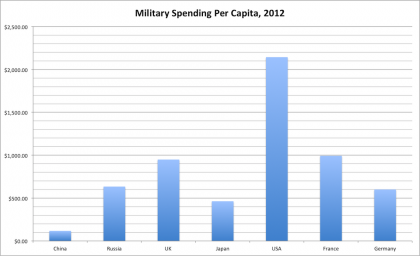
The above figures are taken from the Stockholm International Peace Research Institute’s Military Expenditure Database. For more information, refer to Xiao Tiefeng’s article at the Carnegie-Tsinghua Center for Global Policy, Misconceptions About China’s Growth in Military Spending.