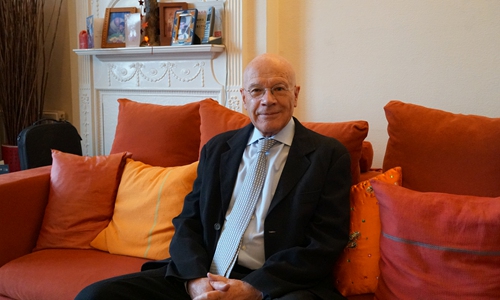
In this interview with Global Times, Martin Jacques, on the 40th anniversary of “reform and opening up”, reviews the significance of Deng Xiaoping’s historic initiative and China’s prospects in the light of the deteriorating relationship with the US in the era of Trump.
This year marks the 40th anniversary of China’s reform and opening up. what do you think of the role the reform and opening up has played in china’s extraordinary changes?
China’s transformation started in 1949, but only in 1978 did China’s economy start to take off in an extraordinary way. It was only then that the Chinese worked out what the appropriate economy strategy was for the country. This was the stroke of genius of Deng Xiaoping.What he proposed was very radical and represented a major shift in the communist tradition. Basically he said two things: firstly, socialism is not synonymous with the state and state planning,but that socialism had to combine both the state and the market. And secondly, he argued that China needed to see itself as part of the whole world, including the capitalist world. China had to live with and compete with and learn from the capitalist world, and not just the socialist world.
This was an intellectual revolution which required a complete rethink and unleashed enormous intellectual energy. This ignited a long process of transformation in China.1978 is one of the most important dates in the 20th century, it prefigured the 21st century: the transformation of China and later the world.
China vows to continue opening up. Some people see this as an opportunity, but some say it’s a threat. How do you evaluate these contradictory views?
One of the great things since 1978 is that China is always thinking, always experimenting, always learning, always trying to work out what is the best way in the situation, in the circumstances that it faces, which are constantly shifting. There’s a general idea of where to go and how to do it. But there’s not a tablet of stone about how to do it; instead of a tablet of stone, you “cross the river by feeling for the stones.” The Chinese combine a general set of principles with a very strong dose of pragmatism.
Itis obviously a lot more complex because China’s economy is many, many times larger now than it was, and China’s impact on the world is now also huge: there are so many more factors China has to consider both internally and globally. China is very interestingly different and distinctive from both the old Soviet mentality and also the West. It has learnt from the West, but it is also very distinctive from the West. It is very important to maintain that. I think one of the reasons for the success of China is its capacity to draw different elements together from different places, different experiences, different traditions, and then combine them in a very unique Chinese way.
Of course, some people think China should be more like America. Now? Really?America is in big trouble, it is in serious long-term decline, which is part of the reason why we got Trump. No, China has to be distinctive. It has to combine those elements which it needs to learn from the West with its socialist and Chinese traditions.
Earlier this year, you wrote an article arguing that the fortieth anniversary of the beginning of the reform period is a cause for celebration and reflection not only in China, but around the world. Can you specify what are the issues that the world, including the Western countries, should reflect on most?
1978 led to the the most extraordinary economic transformation in the modern era. This is much more remarkable than America’s transformation between the 1860s and 1914. It’s a very important event to study. But the West doesn’t think in these terms about 1978, because they don’t really understand any of this.The West is very ignorant about China.
But I would say look, reform and opening up has transformed China. Then,during the 1990s, China began to transform the world and, as a result, the world is now very different from what it was before because of China’s impact. Since 1978 China has been the most important engine of global change. So every country should study China and the Chinese experience.That doesn’t mean that China is a model, but it does mean China is an interesting and important example from which to learn. Many developing countries understand this but the West is still in partial, sometimes total, denial.
On October 4th, the US Vice President Michael Pence made a speech at the Hudson Institute, claiming that US has rebuilt China over the last twenty five years. The US President Trump also mentioned this many times on different occasions. Are you surprised by Pence’s speech?
Not really. You have got to say that the Trump administration,including the Vice President, is many ways remarkably ignorant. Their reaction to American decline is to reassert American nationalism and to try and bully the rest of the world.It’s nonsense to say America is the major reason for China’s transformation over the last 25 years. That tells me that they know nothing about China’s transformation. What planet are they living on to make that kind of remark? It’s obviously just cheap self-serving propaganda. Has America made a contribution to Chinese rise? Yes. It has. As China itself has frequently said, China has been the beneficiary of the era of globalisation which the US played a key role in shaping.
Some American scholars believe that the US has adopted an engagement policy toward China, which has greatly benefited China. But now believe that China has “betrayed” the US and does not intend to follow the US way in terms of its political system. What do you think?
I think a very big political shift has taken place in America. It is not just the Republicans. The Democrats have also shifted to a more anti-Chinese position. Now the question is why, and this is a question that the Chinese themselves need to reflect on.
Until about 2010, America was generally relatively benign towards China.The period after 1972, following the Nixon Mao accord,was characterised by relative stability in the US-China relationship. There were two assumptions that underpinned American attitudes towards China. The first was that China’s economic rise would never challenge America’s economic hegemony. And the second assumption was that China would, in time, become like the West, because they assumed that unless China became like America it could never succeed, its transformation would fail. It would be unsustainable both economically and politically. From 1972 until the Western financial crisis, the relationship remained very unequal, though less so over time.America was the major power. China was the junior partner.
From around 2010, it became increasingly clear that these two positions were wrong. Firstly, because China’s economic transformation continued very successfully and in 2014 overtook the US economy according to GDP measured by ppp. And secondly, it became clear that China was not going to be like America. The political system was not going to become like America’s. Furthermore, China would not accept American global leadership and do whatever America wanted it to do. Two things served to dramatize the situation: one was the Western financial crisis of 2008, the worst in the West since 1931. Suddenly the West was in deep trouble. And, on the other hand, China was not in trouble and China’s rise continued.It shook the confidence of the West. Until this point,America did not believe it was in decline. It had, of course, been in decline for some time, but it was in denial about it. Trump was the product of, and gave expression to, this new uncertainty, angst, disappointment and a growing mood of anger and frustration. This historically explains the shift in the American attitude towards China.
US President Trump frequently summed up his approach to foreign policy with two words: America First. The US has withdrawn from various international mechanisms and is creating barriers for trade, technical exchange, and personal exchanges with a lot of countries. Do you think this will reverse the globalization process and maybe make the world more differentiated or more difficult to access?
I definitely think the era of neo-liberalism has come to an end.There are lots of elements and dimensions to this. Clearly, there’s a reaction to the globalization era in the West. And the ideology of that period in the West, namely neo-liberalism,is in crisis;Trump is a reaction against it. The uber or extreme globalization, which was the western ideology of this period, has hit the wall.
I also think that the whole American view of itself and its role since the end of the second world war has come to an end. I don’t see any simple reversion to the previous era of American multilateralism and leadership. I think that era is over and is unlikely to be revived in its old form. I don’t think we should be so surprised by this because if you look at American history over a much longer period, for example from the War of Independence against Britain until 1939, it was largely dominated by American nationalism and isolationism. The period after 1945 until the election of Trump in 2016, during which America saw itself in terms of multilateral institutions, broad alliances and leadership, was the exception rather than the rule.
Before the second world war, America was always for itself. It was very nationalistic, for long it existed in splendid isolation on its continent. It thought of itself in its own terms. Historically it was very aggressive.It was built on violence, built on slavery, built on wars. Wars against the Amerindians, against Britain, against Spain, against Mexico. That’s how it expanded. So this latest period of American development has been an exceptional period. And Trump lies within the old tradition. He’s reacting against the post-1945 period, he is reverting to the past, by so doing he wants to make America great again, making America as it used to be. Of course, he cannot succeed. Times have changed profoundly.
I don’t think we should expect the Trumpian era to be short lived. There will be no easy or simple return to the status quo ante before Trump.This period could last twenty years, thirty years; a reaction against western-style extreme globalisation. In the long-run, of course, globalization will continue but in the next decade, perhaps much longer, it will suffer setbacks and could even be reversed in certain respects.
Meanwhile, there’s a different globalization taking place, which is what I’ll call Chinese-style globalization with Belt and Road being its most prominent feature. We are moving into a much more complex period, with a much more divided and fragmented world. In this context I think the Pence speech was quite ominous. It was a speech that could have been given in the cold war, it was a very broad attach on China, an attempt to demonize it.It’s not going to be the same as the cold war, but there will be some similarities.
For decades, China has benefited a lot from globalization and the multilateral trading mechanism. What challenges will the current situation bring for China? And what’s your advice on China’s next step on reform and opening up?
I think that what is now deeply preoccupying the Chinese leadership is how to respond to the shift in America, how to understand it and how to deal with it. I think the fortieth anniversary is a reminder of things we should not forget. The wisdom of Deng Xiaoping: keeping your lines of communication open, keeping your curiosity about the world and making as many friends as possible. And I think that those are still good advice.
Read the full article in Chinese here.